Best Web3 Ad Networks in 2026: 10 Platforms Ranked by Results
Finding a Web3 ad network that actually delivers crypto-native traffic is harder than it should be.
So, between January 2025 and January 2026, we tested 17 Web3 advertising platforms to find which were still working and could give you good return on ad spend.
Some were inactive. Others were flooded with bot traffic.
A few were just recycled display inventory with a blockchain label slapped on top.
The 10 best Web3 ad networks on this list passed three tests:
- verified Web3 audience reach
- wallet-level or on-chain targeting capabilities
- documented advertiser results
If you're running Web3 ads in 2026 for a token launch, DeFi protocol, or NFT project, these are the platforms worth your budget.
Here's how the top Web3 advertising platforms stack up:
Now, before we go into full breakdown, let’s give you a quick overview of what Web3 ads are and how they essentially work.
What Are Web3 Ads?
Web3 ads are digital advertisements that run on decentralized infrastructure such as blockchain networks, smart contracts, and peer-to-peer systems.
Unlike Web 2.0 advertising, which relies on cookies and third-party data brokers, Web3 advertising uses on-chain data to reach users. That means the main targeting options available to you becomes on-chain signals like:
- wallet activity
- token holdings
- DeFi interactions
- transaction history
This is why this difference matters. A Google Ads campaign targets someone who searched for "best crypto exchange."
A Web3 ad network targets someone who actually swapped $5,000 on Uniswap last week and holds ETH, USDC, and three governance tokens. Google gives you intent signals. Web3 gives you verified behavior.
How Web3 Advertising Works
Web3 advertising follows a four-step flow.
First, the advertiser creates a campaign and defines their target audience using on-chain parameters — wallet size, token holdings, chain activity, DeFi protocol usage, or NFT ownership.
Second, the Web3 ad network matches those parameters against its publisher network and available wallet profiles.
Third, ads are served across crypto-native placements:
- dApps
- blockchain explorers
- DeFi dashboards
- crypto media sites
- Web3 gaming platforms
… and platforms like Blockchain-Ads take it a step further by tracking identified wallets across crypto-native placements and mainstream publisher networks. This ensures Web3 companies can reach their ideal audience anywhere they hang out on the internet.
Fourth, conversions are tracked either on-chain (wallet connections, token purchases, smart contract interactions) or off-chain (signups, deposits).
Blockchain transparency runs through every step. Every transaction hits a permanent ledger, which cuts hidden fees and lets both parties verify what actually happened.
Ad fraud costs the industry billions annually… but having an immutable record changes that dynamic entirely.
Some platforms, like Blockchain-Ads, combine on-chain wallet data with a traditional DSP/SSP infrastructure for speed and scale. Others handle the entire flow with smart contracts. AdEx, for example, uses on-chain payment channels that settle advertiser-publisher transactions without intermediaries.
The approach varies, but the core principle stays the same: ads reach people based on what they actually do on-chain, not what a cookie profile suggests they might be interested in.
How We Ranked These Web3 Ad Networks
We evaluated 17 platforms and cut 7. Three criteria determined the final list:
Reach and scale — how many real crypto users can this network deliver? We checked publisher quality, monthly impressions, and whether inventory came from actual crypto sites or generic display exchanges.
Targeting precision — does the platform offer wallet-level targeting, on-chain behavioral data, or token-holder segmentation? Networks without any blockchain-native targeting dropped in ranking.
Verified results — we looked for published case studies, named clients, and real performance data. Self-reported traffic numbers without proof didn't count.
Platforms were not paid to appear on this list. Blockchain-Ads is our platform, and we've noted that clearly. Every other network was evaluated on the same criteria.
10 Best Web3 Ad Networks in 2026
The first five platforms on this list are Web3-native, built from the ground up on blockchain infrastructure with wallet targeting, on-chain data, and decentralized advertising delivery.
The remaining five are established crypto ad networks that bring scale and publisher relationships. But they operate more like traditional display networks with a crypto audience.
1. Blockchain-Ads — Best for Wallet-Targeted Web3 Ads

Blockchain-Ads reaches over 12 million verified wallet holders across 9,000+ publisher sites, serving 1 billion daily impressions. It operates as a unified DSP, DMP, and SSP stack — advertisers get targeting, data management, and publisher access in one platform.
What separates Blockchain-Ads from every other network on this list is targeting depth. You can build audiences based on wallet behavior, token holdings, DeFi activity, NFT ownership, and transaction history.
This is different from contextual targeting on crypto websites. You are reaching specific wallet profiles—someone who holds $10K+ in stablecoins and has interacted with lending protocols in the last 30 days.
Major clients include Coinbase, Binance, Crypto.com, and OKX. In one published case study, Coinbase onboarded 31,000 new traders through Blockchain-Ads.
Another campaign for 5ire.org generated 3.84 million impressions, 20,640 clicks, and 170 new token holders.
2. Slise — Best for In-dApp Advertising
Slise places ads directly inside decentralized applications. Not on crypto news sites, but inside the DeFi protocols, NFT analytics tools, blockchain explorers, and Web3 games that active users interact with daily.
Y Combinator alumni founded the company, with a former Facebook AI Research engineer on the team.
Slise’s placement strategy drives results with reports of 0.3–0.4% click-through rate, roughly 3–4x the industry average for display ads. Slise currently reaches over 6 million active crypto users.
CPM rates sit under $10, significantly below the $30–40 that some Web3 advertising platforms charge. In December 2024, W3M Ventures (the media group that also owns A-Ads) acquired Slise, expanding its publisher network.
3. HypeLab — Best for High-Quality Web3 Conversions

Edward Weng, a former Google product manager, founded HypeLab and raised $4 million in seed funding from Shima Capital and Makers Fund. The network runs across 200+ premium crypto publishers with both CPC and CPM bidding and no minimum budget.
HypeLab doesn't aggregate random crypto sites. The network is curated, and the results reflect that.
CoW Protocol reduced customer acquisition cost by 4x with HypeLab's wallet-targeted ads. Exponential.fi reported that HypeLab traffic was 2.3x more likely to convert into signups compared to paid social campaigns on X. HypeLab also handled the MetaMask Portfolio launch campaign.
Targeting covers both on-chain and off-chain signals: wallet activity, location, device type, and crypto interests. The algorithm optimizes campaigns in real-time, making it accessible to projects at any stage — from early testing to scaled acquisition.
4. AdEx — Best for On-Chain Ad Verification
AdEx is a Web3 advertising platform that uses smart contracts to handle every transaction between advertisers and publishers.
AdEx has been building blockchain-based advertising infrastructure longer than most networks on this list have existed.
Every AdEx account is essentially a smart contract wallet through the v5 Ambire Wallet integration. Campaigns lock budget on-chain, and payment channels settle automatically based on verified ad delivery. Every impression and payment is verifiable on the blockchain.
AdEx supports native and banner formats. In 2025, they launched AURA, an AI agent framework for automating DeFi strategies. The ad platform remains self-serve and open-source.
5. Adshares — Best for Metaverse and In-Game Ads
Adshares is a full blockchain ecosystem built specifically for advertising. The project runs on its own proprietary blockchain (dPoS consensus) handling 1.4 million transactions per second. The ADS token powers every ad settlement between publishers and advertisers.
Media diversity is the strongest angle. Most Web3 ad networks are limited to display banners on websites.
Adshares supports programmatic ads across metaverse environments (Decentraland, CryptoVoxels), blockchain games, mobile apps, AR/VR platforms, and traditional websites. The open-source SDK allows any developer to build their own ad server on top of the protocol.
Over 2,000 advertisers and hundreds of publishers have used the ecosystem since its 2017 launch. If your strategy includes metaverse or in-game placements, Adshares is the only real option.
6. Coinzilla — Ad Network Supporting Web3 Advertising
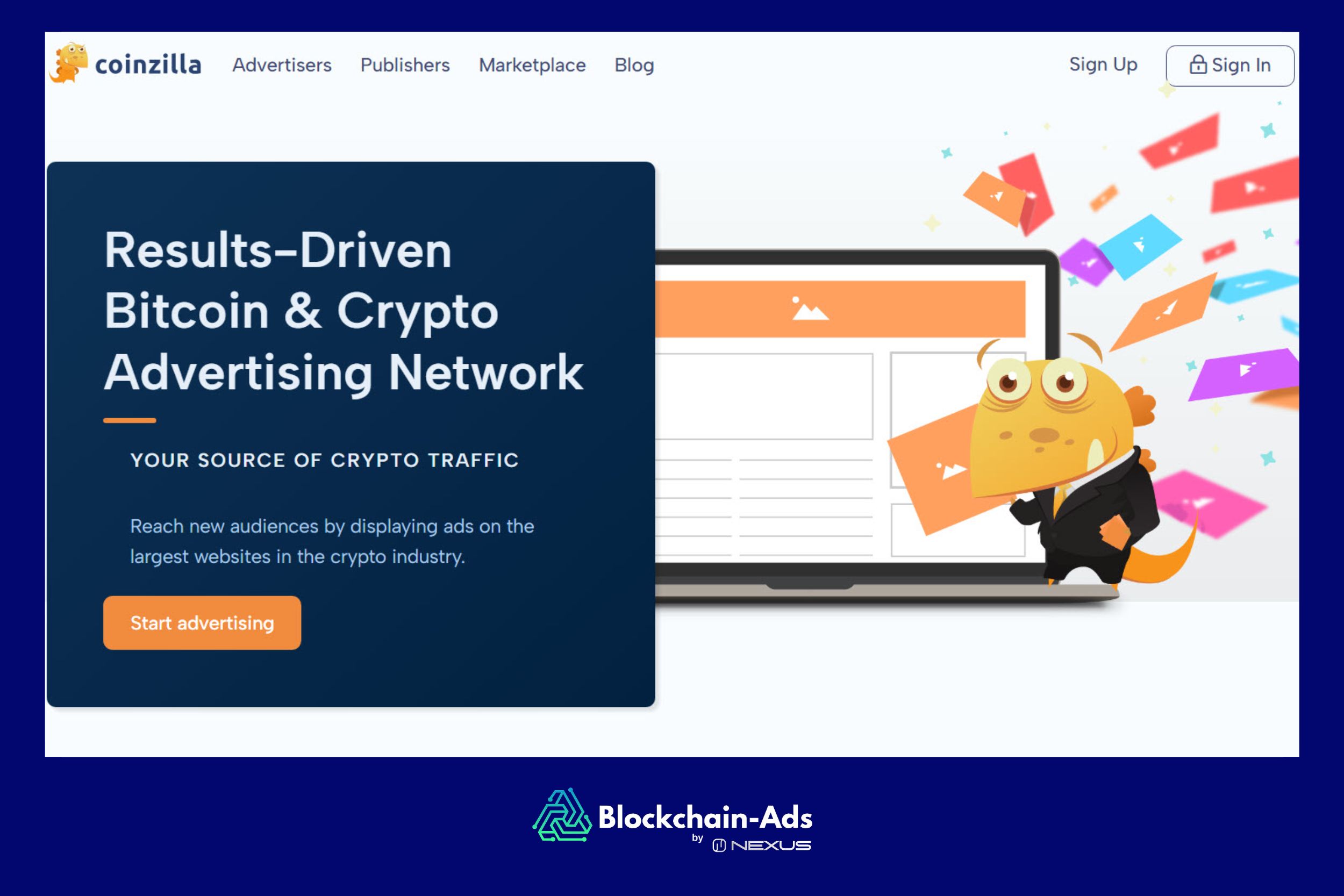
Coinzilla launched in 2016 and remains the longest-running crypto ad network still operating at scale. Their capacity is at 1 billion+ monthly impressions across 2,000+ publishers including CoinGecko, DEXTools, and Etherscan.
Coinzilla doesn’t use wallet targeting here. This is traditional display advertising for the crypto space: reach, reliability, and established relationships with premium publishers.
The ad network offers display banners, native ads, press releases, sticky banners, and pop-unders. Their managed service includes content writing and banner creation for advertisers who want a hands-off approach.
7. Bitmedia — For Contextual Web3 Ad Campaigns
Bitmedia, based in London, uses AI to match ads with relevant audiences and continuously optimize delivery based on user behavior patterns.
Bitmedia recently added wallet targeting, moving closer to the Web3-native networks higher on this list, though not as deep as Blockchain-Ads or HypeLab yet. Rich media, HTML5, and standard display formats are all supported.
At $10 minimum spend, Bitmedia is one of the most accessible networks for new advertisers. AI handles optimization automatically, making it a strong choice for teams without dedicated ad ops staff.
Solid for top-of-funnel crypto awareness; projects chasing bottom-funnel wallet conversions will find more precision in the Web3-native platforms above.
8. Cointraffic — Best for Premium Placements and PR

Operating since 2014, Cointraffic is one of the oldest players in crypto advertising. 600+ vetted publishers. 700 million monthly impressions. This is a quality-over-quantity play focused on premium inventory.
€1,000 minimum campaign spend filters out low-budget advertisers and signals who Cointraffic is built for: projects with real budgets that need reliable, high-quality placements.
They're active on the conference circuit (Token2049 Singapore, WikiFinanceExpo Hong Kong), which keeps publisher relationships fresh and inventory quality high.
Display, native, and sticky banner formats come alongside press release distribution — one of the few networks where you can run paid media and earned media from the same platform. No wallet targeting, so this is traditional crypto display. But if your priority is premium, recognizable placements, Cointraffic delivers.
9. A-Ads — Best Budget-Friendly Web3 Ad Network
Launched in 2011 when Bitcoin traded at single digits. A-Ads (formerly Anonymous Ads) is the oldest crypto ad network still in operation. It takes a privacy-first approach with no KYC requirements for advertisers or publishers and no personal data collection.
You can start a campaign with literally any budget, pay in Bitcoin or other cryptocurrencies, and be running ads within minutes. A-Ads operates on a CPM model with geo-targeting and traffic source category filters.
A-Ads is now part of W3M Ventures, the same media group that owns Slise.
Best suited for top-of-funnel awareness campaigns or projects testing crypto advertising without significant budget commitment. Don't expect precision targeting or high-converting traffic — this is volume-based advertising at low cost.
- Reach: 372M daily impressions
- Targeting: Geo, traffic source categories
- Ad formats: Display banners
- Pricing: No minimum spend, pay in crypto
- Best for: Budget testing, top-of-funnel awareness, privacy-focused advertisers (no KYC)
- Downside: Lower traffic quality; no wallet targeting; limited ad formats
10. Brave Ads — Best for Mainstream Web3 Audience Crossover
Brave Ads operates inside the Brave Browser, the only platform on this list where users explicitly opt in to see ads and earn 70% of ad revenue in BAT (Basic Attention Token) for their attention.
Brave Ads runs a fundamentally different model from every other network here. It doesn't target using wallet data or on-chain activity. All ad matching happens on-device using browsing behavior, and that data never leaves the user's device.
Privacy-first approach that sacrifices targeting precision for user trust and engagement quality. Formats include new tab page backgrounds, push notification ads, and Brave News feed placements.
Brave users skew tech-savvy, privacy-conscious, and crypto-native — but the 100M base includes significant mainstream overlap.
Verizon, The New York Times, Chipotle, and Amazon have all run Brave campaigns alongside crypto-native companies. Minimum spend is around $10,000.
If your project needs mainstream reach with crypto audience density, Brave bridges Web3 and Web2 advertising.
Why Web3 Ad Networks Exist
Web3 ad networks exist because Meta Ads and Google Ads still restrict web3 advertising in most categories. Exchanges and wallets can advertise in select countries with proper licensing, but DeFi protocols, token launches, and NFT projects face outright bans or constant policy rejections.
Cost is the other factor. Crypto keywords on Google run $15–25+ per click. Web3 ad networks operate on CPM models between $2–15, giving you significantly more impressions for the same budget.
That said, Google Ads and Meta Ads aren't useless for crypto companies. It works for educational content, exchange signups in licensed markets, and brand search defense.
But for direct Web3 user acquisition, purpose-built networks outperform on reach, targeting, and cost.
How Much Do Web3 Ads Cost?
Most Web3 ad networks operate on CPM (cost per thousand impressions) pricing. Industry benchmarks for crypto advertising in 2026:
- CPM: $2–15 on most networks; wallet-targeted campaigns on premium inventory can reach $20–40
- CPC: $0.10–2.00 depending on targeting and competition; DeFi keywords trend higher
- CPA: $5–50 for wallet connections; $20–200+ for token purchases depending on conversion value
Compare this to Google Ads, where crypto keywords like "crypto exchange" or "buy bitcoin" can exceed $15–25 per click. Web3 ad networks deliver crypto-qualified impressions at a fraction of that cost.
For testing, start with $500–2,000 on a self-serve platform like Slise or Bitmedia.
For full-funnel campaigns with wallet targeting, plan for $10,000+ monthly to generate statistically meaningful conversion data.
Web3 Ad Formats
Display banners remain the most common format. Standard IAB sizes (728×90, 300×250, 320×50) work on every network listed here. Easy to create, widely supported, effective for brand awareness at scale.
Native ads blend into publisher content feeds and typically produce higher engagement than standard banners. Coinzilla, Cointraffic, and Bitmedia all support native placements.
In-dApp placements are unique to Web3-native platforms. Slise and HypeLab serve ads directly inside decentralized applications — DeFi dashboards, blockchain explorers, Web3 gaming interfaces. These placements reach users at the moment of on-chain activity, converting at 3–4x higher rates than standard display.
Video ads are supported by Blockchain-Ads and HypeLab. Best for token launches and product explainers where you need more than a static image.
Metaverse placements are an Adshares specialty. Billboard-style ads inside Decentraland, in-game advertising in blockchain games, and AR/VR overlay placements.
Browser-native ads are exclusive to Brave — new tab page takeovers, push notifications, and news feed sponsored content.
Connected TV is the newest addition, offered by Blockchain-Ads. CTV ads put crypto brands on streaming platforms, reaching audiences in a format traditionally reserved for large consumer brands.
How to Set Up a Web3 Ad Campaign
Setting up a Web3 advertising campaign follows a straightforward process, regardless of which ad network you choose.
Step 1: Define Your Campaign Objective
What does success look like? Wallet connections, token purchases, protocol signups, or brand awareness? Your objective determines which network and targeting approach makes sense. Token launches prioritize reach and urgency. DeFi protocols prioritize wallet-qualified traffic. Brand campaigns prioritize premium placement. Get specific about the action you want users to take.
Step 2: Choose a Network and Budget Model
Match your objective to a platform. Wallet-level targeting with budget? Blockchain-Ads or HypeLab. Active dApp users? Slise. Broad reach at low cost? A-Ads or Coinzilla. Check minimum spend requirements — they range from nothing (A-Ads) to $10,000+ (Blockchain-Ads, Brave). Most Web3 ad networks offer CPM pricing; some support CPC or CPA. Select based on whether you're optimizing for impressions, clicks, or conversions.
Step 3: Set Up Targeting and Launch
Create your campaign in the platform's dashboard. For wallet-targeted networks, define your audience using on-chain parameters: token holdings, DeFi activity, transaction recency, chain preference. For traditional crypto ad networks, select geos, devices, and publisher categories. Upload your creative assets (most platforms accept standard IAB banner sizes) and set your daily or total budget. Launch and let the first data come in.
Step 4: Track, Optimize, Scale
Monitor performance daily during the first week. Check CTR, conversion rate, and cost per acquisition. Most platforms offer real-time dashboards — wallet-targeted networks can show on-chain conversion events. Kill underperforming placements, increase bids on high-performers, and test new creative variations. Once you identify what works, scale budget toward winning segments. For more detail on Web3 marketing strategy, see our dedicated guide.
How to Measure Web3 Ad Performance
You can measure your Web3 ad performance using the key metrics below:
- Impressions and reach — How many times was your ad shown and to how many unique wallets? Wallet-targeted networks can deduplicate by wallet address, giving you true unique reach instead of cookie-based estimates.
- Click-through rate (CTR) — Industry benchmark for crypto display is 0.1–0.15%. Wallet-targeted in-dApp placements often hit 0.3–0.5%. Below 0.1%? Test new creative or tighten targeting.
- Conversion rate — What percentage of clicks lead to a desired action? Define your conversion clearly: wallet connection, token purchase, protocol interaction, signup. Expect 2–5% for low-friction actions (email signup) and 0.5–2% for high-friction actions (token purchase).
- Cost per acquisition (CPA) — Total spend divided by conversions. Track CPA by network, placement, creative, and audience segment to identify what's working.
- Return on ad spend (ROAS) — Revenue generated divided by ad spend. For token projects, track the dollar value of tokens purchased. For DeFi protocols, measure TVL acquired from campaign traffic.
On-Chain vs Off-Chain Attribution
Most Web3 ad networks offer standard tracking (pixels, postbacks, UTM parameters) for off-chain conversions like signups and deposits. Platforms with deeper blockchain integration — Blockchain-Ads, AdEx, and Slise — also offer on-chain conversion tracking.
On-chain attribution measures wallet connections, token purchases, and smart contract interactions generated by your campaign. You can see not just that someone clicked your ad, but that their wallet subsequently interacted with your protocol or purchased your token.
For DeFi and token projects, this is essentially the only way to prove ad spend drives actual protocol usage rather than just website traffic.
Web3 Ads in Your Marketing Stack
Paid ads are one channel. Most successful Web3 projects combine them with organic community building, influencer partnerships, PR, and content marketing.
Web3 ads work best for direct response — token launches, protocol signups, wallet connections. They're measurable, scalable, and reach verified on-chain users. But they don't build community or earn trust on their own. A wallet holder who clicks your ad still needs to see social proof, understand your value prop, and trust your team before converting.
The strongest campaigns use Web3 ads to amplify what's already working. Run ads to your best-performing content. Retarget users who engaged with your community. Drive traffic to landing pages that convert because your brand already has credibility.
For a complete breakdown of how paid, organic, and community channels work together, see our crypto marketing strategy guide.
Frequently Asked Questions
What is a Web3 ad network?
An ad network that uses blockchain data — wallet activity, token holdings, on-chain behavior — to target crypto audiences. Unlike traditional ad networks, they don't rely on cookies.
Which Web3 ad network is best for token launches?
Blockchain-Ads. Wallet-level targeting lets you reach users who've participated in previous launches, and 1B+ daily impressions give you launch-day scale.
Can you run Web3 ads without wallet targeting?
Yes. Coinzilla, Cointraffic, A-Ads, and Brave don't use wallet targeting. They reach crypto audiences through publisher placement or behavioral matching. Good for brand awareness, lower conversion rates.
How much do Web3 ads cost?
CPMs range from $2–15 on most networks. A-Ads has no minimum. Coinzilla starts at €20. Blockchain-Ads and Brave require $10,000+. See the pricing table above for full breakdown.
What's the difference between Web3 ads and crypto ads?
"Crypto ads" includes any advertising for crypto products (Google, social, influencers). "Web3 ads" specifically use blockchain infrastructure for targeting or verification. All Web3 ads are crypto ads, but not vice versa.
Do Web3 ad networks work for non-crypto projects?
Rarely. Brave reaches mainstream users — Verizon and NYT have run campaigns there. But most Web3 networks are purpose-built for crypto. Non-crypto brands typically get better ROI elsewhere.
How do I track conversions from Web3 ads?
Standard tracking (pixels, UTMs) for off-chain conversions. Blockchain-Ads, AdEx, and Slise also offer on-chain tracking — wallet connections, token purchases, smart contract interactions.
Are Web3 ad networks safe from bot traffic?
Wallet-targeted networks (Blockchain-Ads, Slise, HypeLab) are safer — verifying real wallet activity filters bots by default. Traditional display networks (Coinzilla, A-Ads) carry more risk.
What industries benefit most from Web3 ads?
DeFi protocols, NFT projects, blockchain games, crypto exchanges, token launches, and wallet providers. Projects without a blockchain component typically get better results elsewhere.
Can I pay for Web3 ads with fiat?
Most networks accept both crypto and fiat. Coinzilla, Bitmedia, HypeLab, Blockchain-Ads, and Cointraffic take cards or bank transfers. AdEx and Adshares use native tokens. A-Ads is crypto-only.
What ad formats work best for DeFi projects?
In-dApp placements from Slise and HypeLab. They reach users inside protocols they're already using — higher intent, higher conversion rates than standard display.
How does wallet targeting improve ROI?
You're reaching users based on verified on-chain actions, not inferred interest. Less waste, higher CTR, better conversion rates, lower CPA.
.png)