
Crypto Marketing Strategy: The Complete Guide
Key takeaways
- Start with outcomes: Build your crypto marketing strategy backward from the customer action that supports your business goal.
- Choose relevant channels: Match your audience and conversion goal to the channels most likely to reach qualified users.
- Measure conversions: Track sign-ups, wallet connections, first deposits, or trades according to each campaign's objective.
- Budget for testing: Set aside resources to test audiences, creatives, and channels before increasing spend.
- Optimize after launch: Use conversion data to identify which campaigns deserve more budget and which need adjustment.
Crypto marketing starts with a practical challenge: your product is live, you have a budget to spend this quarter, and you need to show what that investment produced. Sign-ups, community members, and website traffic matter, but they don't necessarily tell you how many customers deposited funds or started trading.
A crypto marketing strategy connects your business goal to the customer action you want, the audience most likely to take it, and the channels you can use to reach them. It also establishes how much to spend, what to test, and how to measure performance.
What Is Crypto Marketing?
Crypto marketing is the process of attracting, acquiring, and retaining users for cryptocurrency and blockchain-based products through paid advertising, content, communities, partnerships, and other acquisition channels.
Cryptocurrency marketing focuses on specific actions, such as:
- Creating an exchange account
- Connecting a wallet
- Depositing funds
- Completing a transaction
The channels you choose depend on the product and the action you want users to take. An exchange trying to acquire funded traders needs a different approach from a DeFi protocol seeking wallet connections or a token project building an active community.
Who Uses Crypto Marketing
Exchanges, wallets, DeFi protocols, trading apps, and token projects use crypto marketing to attract users, build trust, and encourage participation in their products.
Here’s how some of these businesses use it:
- Crypto exchanges: Acquire registered users, completed KYC verifications, first deposits, and active traders.
- Crypto wallets: Attract new users, encourage wallet creation, and increase meaningful wallet activity.
- DeFi protocols: Reach users interested in lending, staking, swapping, and other supported on-chain activities.
- Trading apps: Acquire traders, encourage first deposits, and increase trading activity.
- Token projects: Build awareness, attract relevant token holders, and encourage participation in the project's ecosystem.
How Crypto Marketing Differs From Traditional Marketing
Crypto marketing differs from traditional marketing in several ways that shape how you build a crypto digital marketing strategy:
- Advertising restrictions: Crypto exchanges, wallets, and token-related products face platform-specific eligibility requirements. For example, Google restricts cryptocurrency advertising based on the product, advertiser certification, and target market.
- Audience targeting: Beyond demographics and interests, crypto advertisers can use wallet activity, token holdings, and protocol interactions to identify relevant audiences.
- Conversion measurement: A registration or app install may be an intermediate step. Exchanges need to know whether users deposit or trade, while DeFi protocols may prioritize completed on-chain transactions.
How to Build a Crypto Marketing Strategy
A crypto marketing strategy starts with a business goal. Then it connects that goal to a measurable customer action, a defined audience, and the channels most likely to generate results.
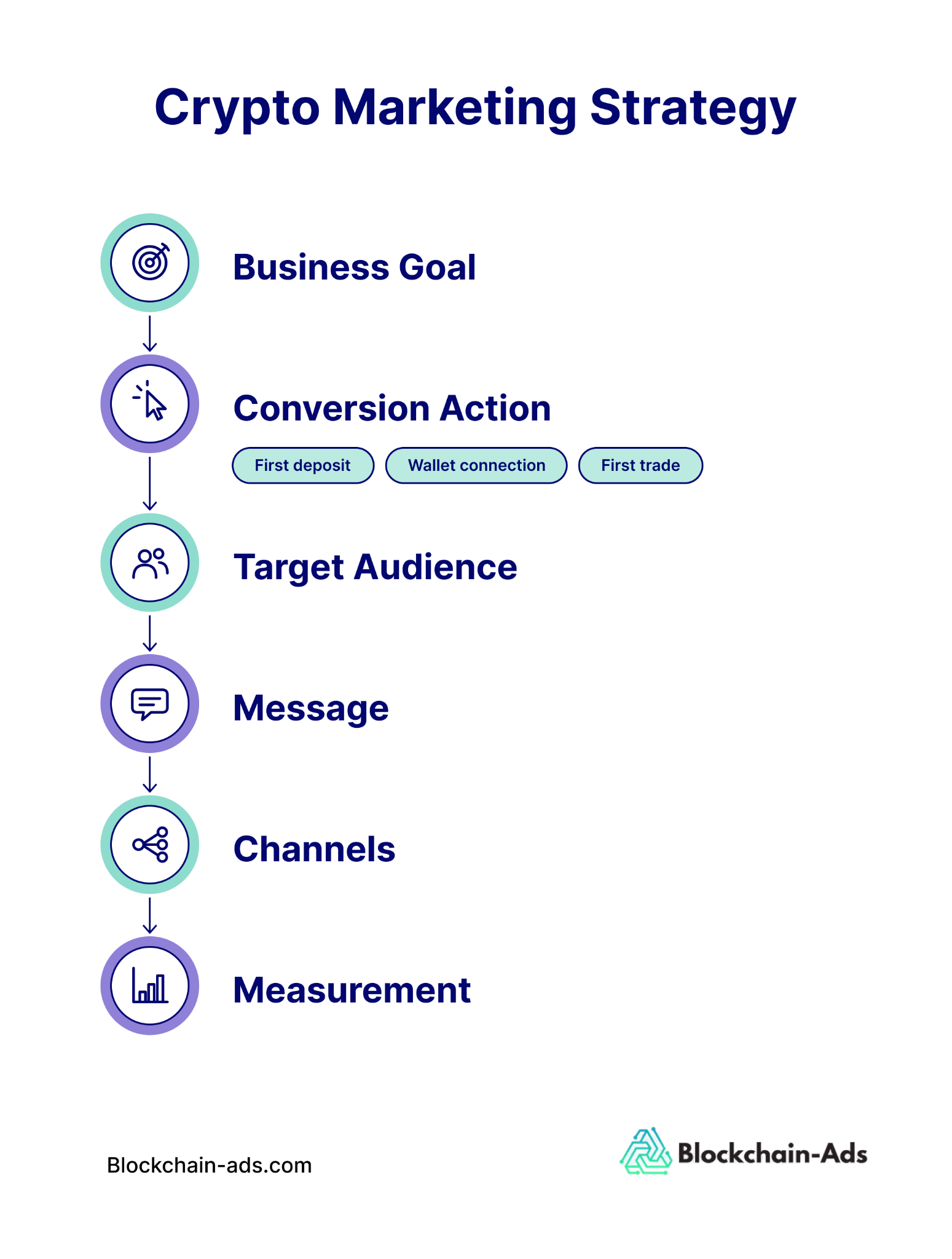
Set the Goal for Each Campaign
Give each campaign one primary goal based on the business outcome you're trying to achieve.
For example, crypto marketing campaigns might focus on:
- Increasing first deposits
- Encouraging wallet activation
- Re-engaging inactive traders
- Acquiring new exchange users
Choose the Action Each Campaign Is Judged On
Choose a conversion event that demonstrates progress toward the campaign's goal.
For an exchange, that might be completing registration, making a first deposit, or making a first trade. For a wallet, it could be creating a wallet or making an initial transaction.
Record the primary conversion event and the downstream business outcome. If you optimize a campaign for registrations, also track how many registrants become funded or active users.
Define Your Audience by Wallet Activity
Dig deeper than broad crypto-related interests and define audiences using behaviors that indicate potential interest in your product.
For example, an exchange could prioritize active traders, while a DeFi lending protocol might target users who already interact with lending applications.
Blockchain-Ads Wallet Targeting uses on-chain activity across 11M+ wallets and 82 chains to build audiences based on token holdings, trading behavior, and protocol usage. Prebuilt audiences include on-chain traders, token holders, DeFi users, and crypto app users.
Shape Your Positioning and Message
Your campaign message should explain why the target audience should choose your product and what action to take next.
Connect the message to the audience's needs and your product's actual advantages. An exchange might emphasize supported trading pairs or fees, while a wallet might focus on supported networks and security features.
Keep the promise consistent across the ad, landing page, and onboarding experience. This approach helps users find what the campaign advertised when they arrive on your page or engage with your product.
Choose Your Channels
Choose channels based on their ability to reach your audience and generate the campaign's desired action.
Once you've defined your audience and conversion goal, compare how different channels can contribute to that outcome. Paid advertising can help you quickly test acquisition audiences, while SEO captures existing search demand. Communities, creators, and partnerships can introduce your product to relevant audiences.
Crypto Marketing Strategies That Work
The most effective crypto marketing strategies combine channels that reach qualified audiences with campaigns designed to produce measurable customer actions. Here are nine approaches to consider based on your goals.
Paid Advertising
Paid advertising helps you reach targeted audiences and test which messages generate registrations, deposits, or trades. Your crypto advertising strategy should define a conversion event, audience, and testing budget before launch.
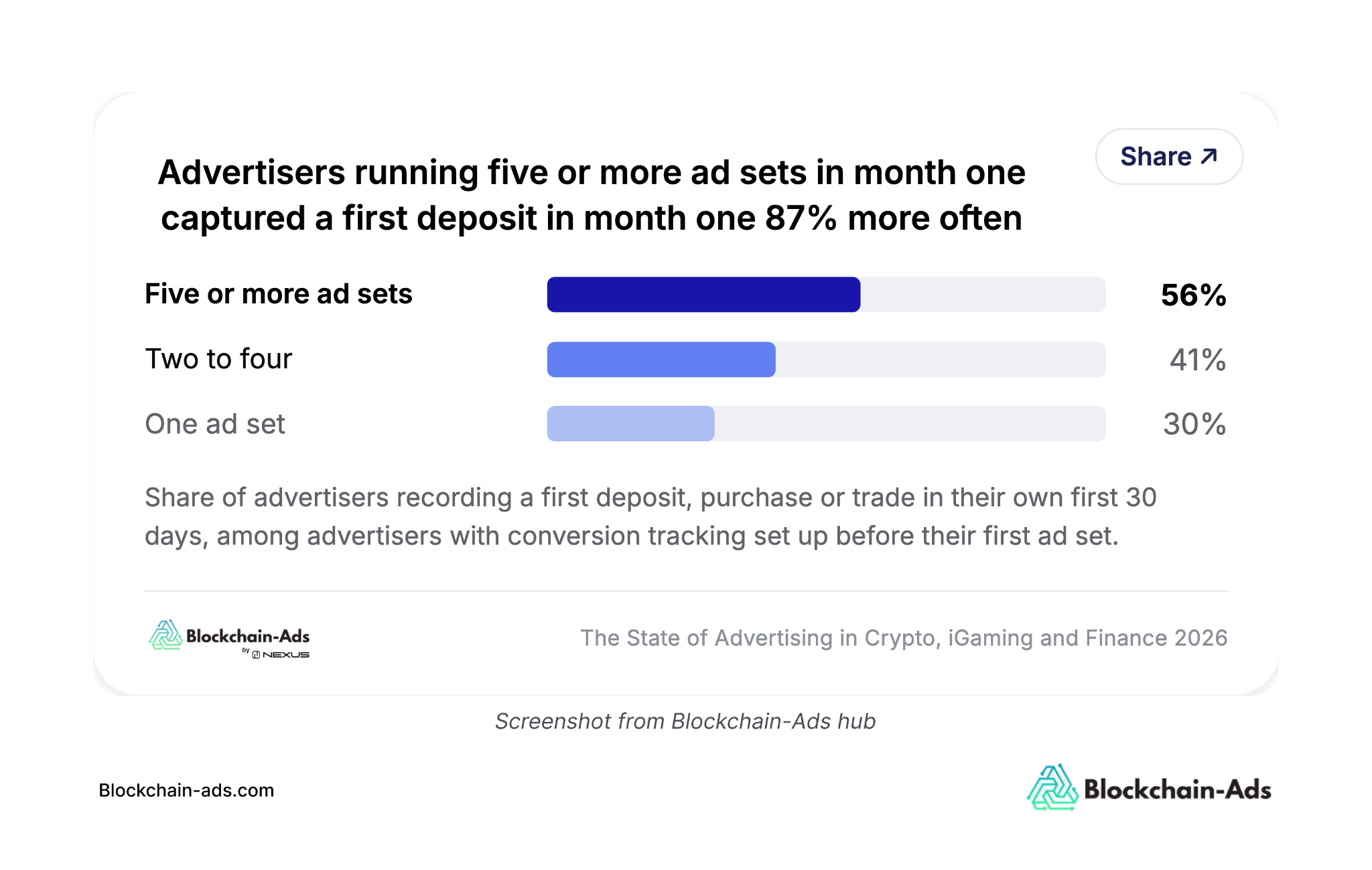
The State of Advertising in Crypto, iGaming, and Finance 2026 report analyzed 200+ advertisers across multiple industries and came to a conclusion. Advertisers running five or more ad sets in month one captured a first deposit that month 87% more often than those running one (56% versus 30%).
Community Building on Discord, Telegram, and X
Build communities where users can ask questions, receive updates, and discuss your product. Use Discord for structured discussions, Telegram for announcements and support, and X for public conversations.
Measure participation alongside downstream actions, such as community members who register or connect wallets.
Influencer and KOL Marketing
Partner with creators whose audiences match your target users. Evaluate their credibility and previous engagement rather than relying on follower counts alone.
Give each creator a trackable link or referral code, then measure registrations, deposits, or other qualifying actions attributed to the partnership. It’s also recommended for creators to clearly disclose paid partnerships or sponsored content. This way, audiences can distinguish promotional recommendations from independent opinions.
Content Marketing and SEO
Create content around the problems users search for before choosing a crypto product. Exchanges might target trading fees and supported assets, while wallets could address network compatibility and security questions.
Track rankings, but also pay attention to organic traffic, qualified registrations, and subsequent activation.
Crypto PR
Use crypto PR to communicate product launches, partnerships, research findings, and other developments worth reporting.
Pitch relevant publications with verifiable information and a clear story. Then, evaluate coverage through relevant referral traffic, branded search demand, and attributable conversions.
Social Media Marketing
Use X, LinkedIn, and other relevant platforms to distribute educational content, product updates, and community discussions.
Match the platform to your audience and give posts a clear purpose. Track referral visits, sign-ups, and engagement that contributes to meaningful customer actions.
Email Marketing
Use permission-based email campaigns to nurture prospects and encourage users to complete onboarding.
Segment messages by lifecycle stage. For example, remind registered users who haven't funded their accounts about available onboarding steps, then measure completed deposits rather than email opens alone.
Airdrops, Quests, and Referral Programs
Airdrops, quests, and referrals can encourage participation through defined tasks or user invitations.
For crypto token marketing, tie rewards to meaningful, verifiable actions where appropriate. Reward claims alone can overstate campaign success because participants may collect incentives without becoming active users.
Measure retained participants and subsequent product activity while checking applicable legal requirements.
Partnerships
Collaborate with wallets, protocols, communities, and complementary crypto services that serve similar users.
Partnerships can include integrations, co-marketing campaigns, and referral agreements. Define the expected outcome upfront, assign tracking links or partner identifiers, and compare the acquired users' activation rates and costs.
How Much Does Crypto Marketing Cost?
Crypto marketing cost depends on your target audience, chosen channels, campaign objectives, and the resources needed to acquire customers. Each channel has a different cost structure.
One pump.fun campaign on Blockchain-Ads shows what paid advertising can cost against a deep action. Over five months, it spent $240,760 on display ads across North America, Western Europe, Brazil, and Southeast Asia to acquire 2,250 active wallets. Each of these wallets created or traded a token within 7 days. That is a $107 CPA per active wallet.
But note that costs always vary by product, market, and creative.
What Drives the Cost
Several factors determine how much you'll spend:
- Audience and geography: Competition for your target users and the markets you want to reach.
- Campaign objective: Whether you're pursuing awareness, registrations, deposits, or trades.
- Creative production: The cost of producing ads, landing pages, videos, and other campaign assets.
- Campaign management: The people, tools, and resources required to run and optimize campaigns.
Cost by Channel
Compare channel costs based on what you'll pay for and the customer actions each channel can generate.
How to Set a Crypto Marketing Budget
Build your crypto marketing budget around the channels you can measure against your acquisition goals.
For example, suppose you have a $30,000 quarterly budget to acquire funded traders. You could prioritize paid advertising to test acquisition campaigns and generate early conversion data. Then you invest in content for long-term organic traffic and use influencers and community management to reach and engage potential users. A separate reserve lets you test new approaches or increase spending on high-performing campaigns.
This is only an illustrative allocation. Use your acquisition costs and conversion data to adjust the amounts. Increase spending on channels generating qualified users at an acceptable cost, and reduce allocations where performance falls short.
How to Build a Crypto Marketing Plan
A crypto marketing plan turns your strategy into a sequence of activities, deadlines, and performance checks. Organize the plan into three phases:
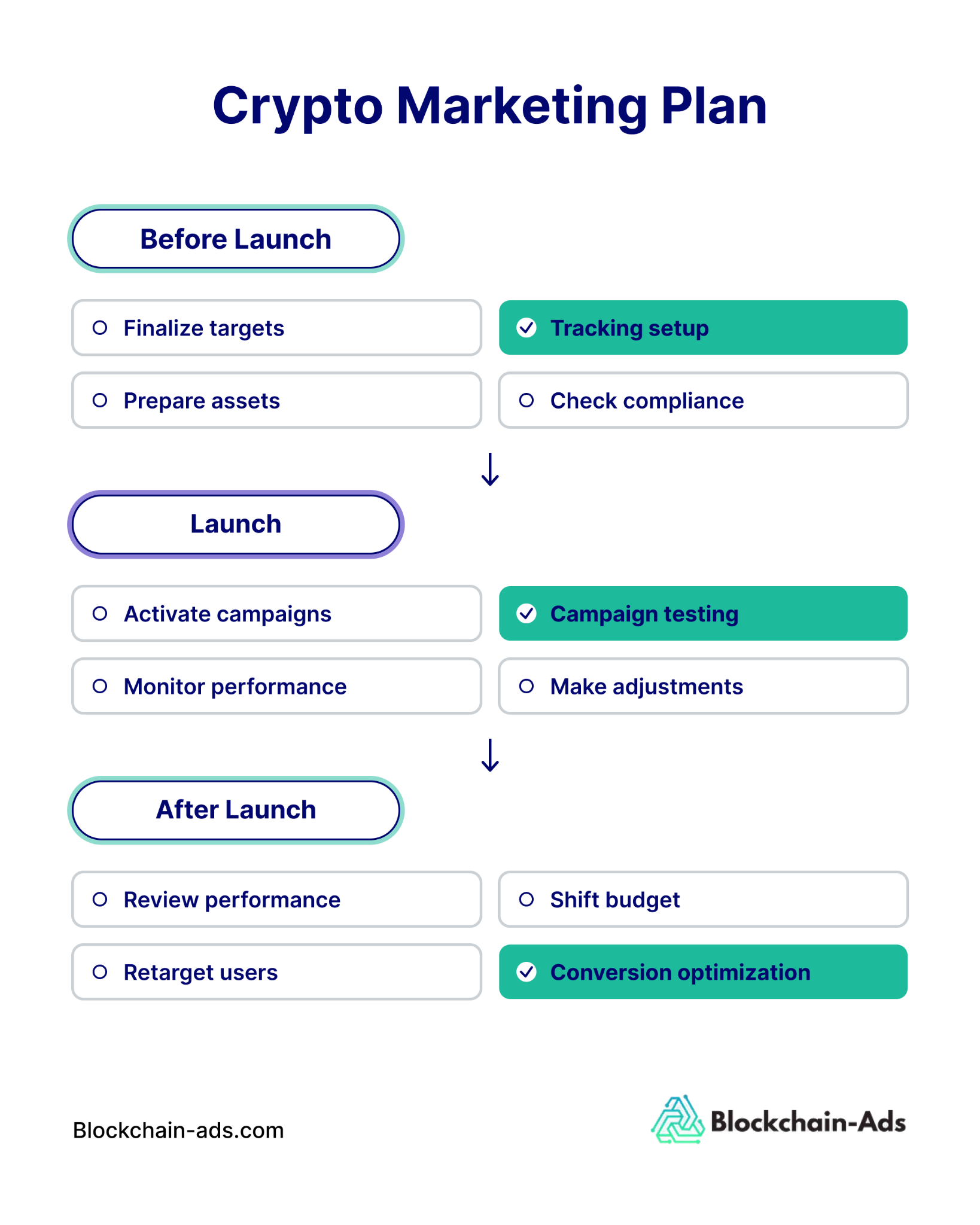
Before Launch
Prepare your campaigns, tracking, and creative assets before committing your acquisition budget.
- Finalize your targets: Document the budget, channels, conversion events, and acceptable acquisition costs for each campaign.
- Set up tracking: Configure analytics, conversion events, and attribution so you can follow users from their first interaction to registration, deposit, or trade.
- Prepare campaign assets: Build landing pages, advertising creatives, email sequences, and other materials needed for each channel.
- Check compliance: Confirm that your ads, claims, and landing pages meet applicable platform policies and regulatory requirements.
Launch
Start with controlled campaigns that help you identify which audiences, messages, and channels generate qualified users.
- Activate campaigns: Launch your selected channels with defined budgets and conversion events.
- Test variations: Compare audiences, creatives, and messaging while keeping the primary conversion goal consistent.
- Monitor performance: Review spend, conversion tracking, and early acquisition results to spot delivery or measurement issues.
- Make adjustments: Fix technical issues and obvious inefficiencies before making larger budget changes.
After Launch: Crypto Growth Marketing
Crypto growth marketing focuses on improving acquisition efficiency and turning newly acquired users into active customers.
Review performance against the conversion event assigned to each campaign, then examine how those users progress toward deposits, trades, or other valuable actions.
Shift budget toward campaigns producing qualified users at an acceptable cost. Use retargeting and lifecycle communications to re-engage users who registered but haven't completed the next step.
Continue testing new audiences and messages, but evaluate improvements using downstream conversion data rather than clicks or registrations alone.
How to Measure Crypto Marketing
Measure crypto marketing performance against the conversion action assigned to each campaign. Then, track how those conversions contribute to deposits, trades, or other business outcomes.
Start by defining the metrics that show whether each campaign is achieving its goal.
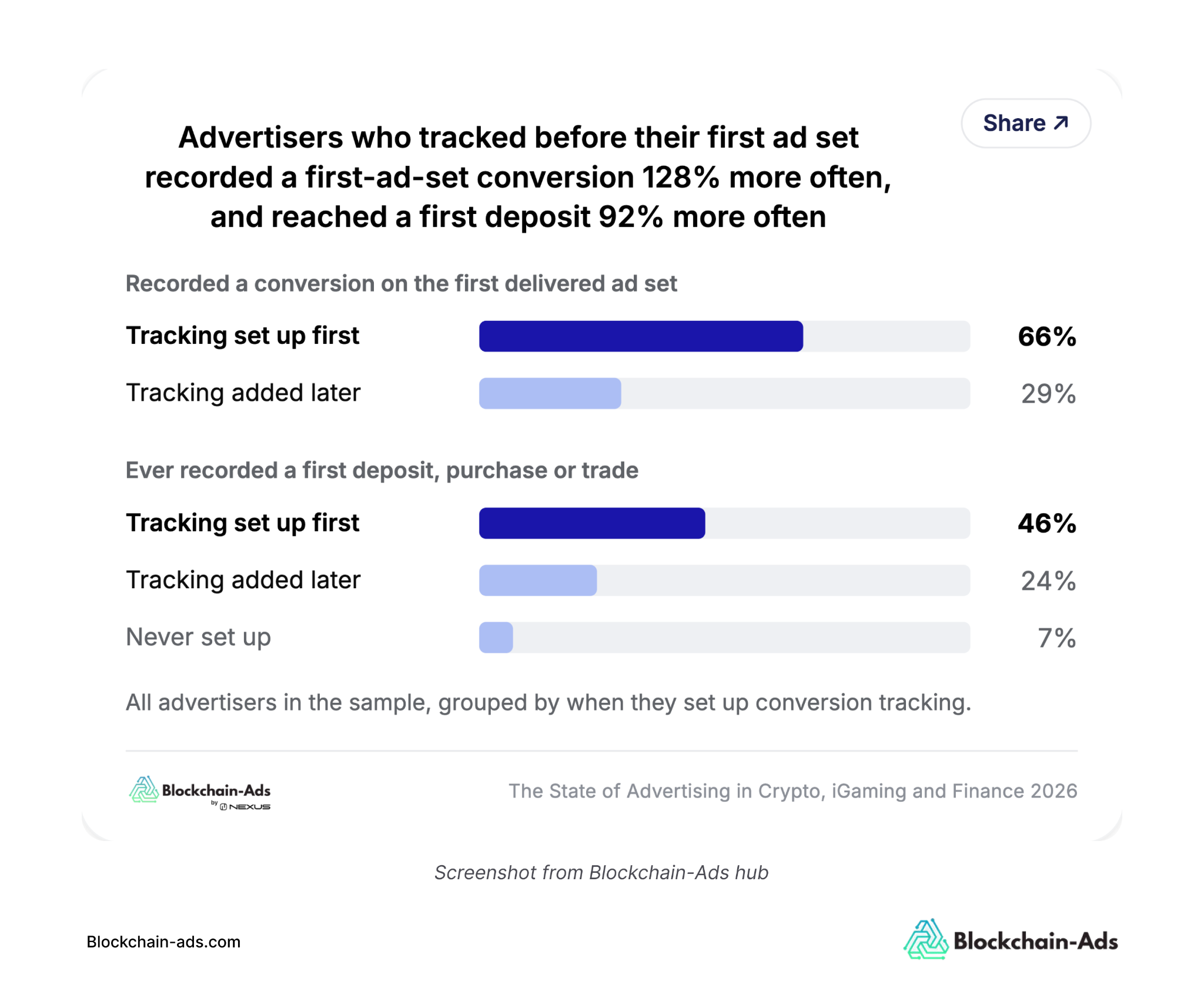
The timing of your tracking setup also matters. In the same study, advertisers who configured tracking before launch reached a first deposit or trade 92% more often than those who didn't (46% versus 24%). Before spending your budget, verify that your tracking captures these conversion events and attributes them to the campaigns that generated them.
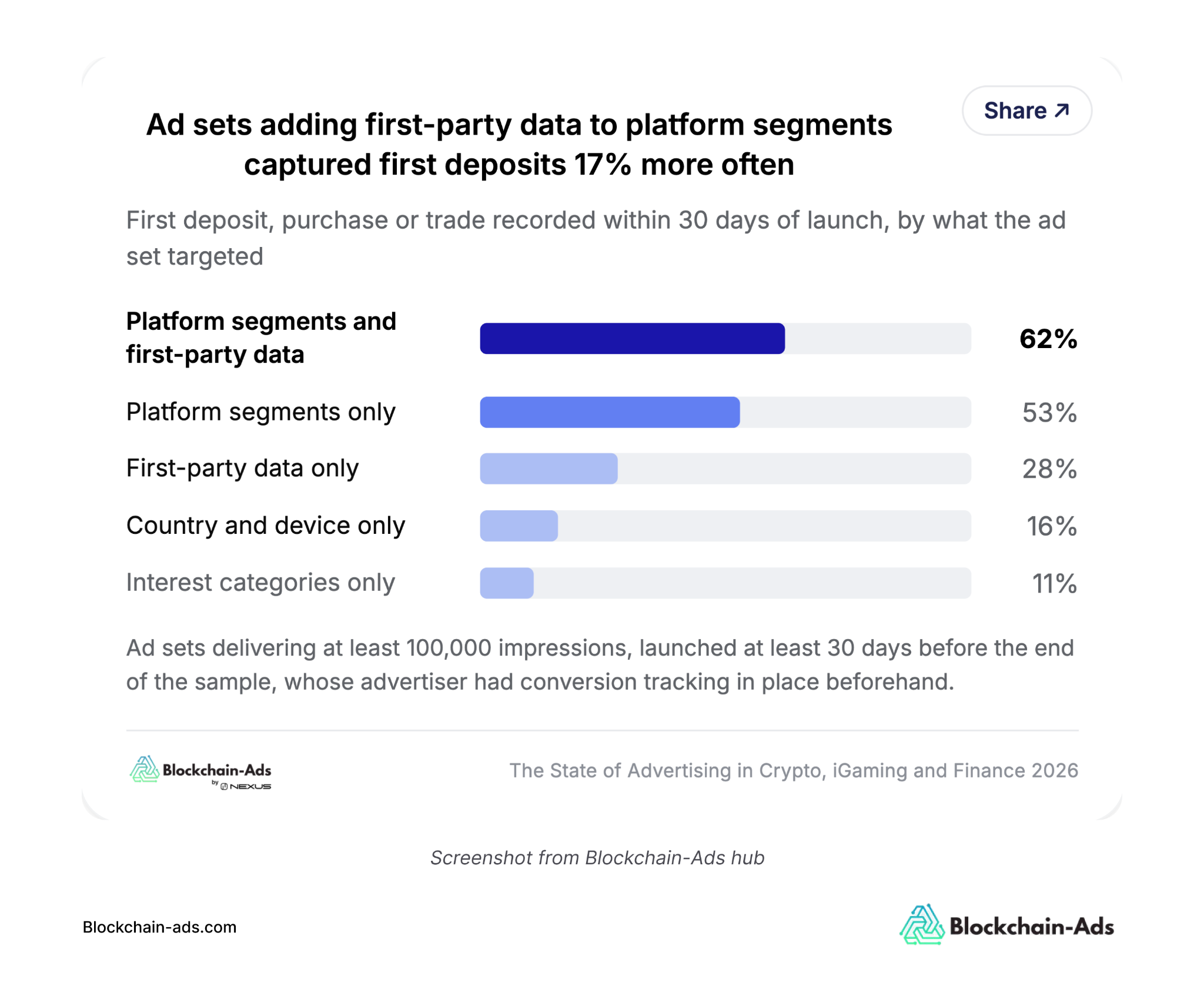
Audience targeting is another factor to assess. Ad sets combining platform segments with first-party data captured first deposits 17% more often than platform segments alone (62% versus 53%). Use your existing customer and conversion data to refine platform audiences, then compare first-deposit rates to see whether the combined targeting performs better.
Review these metrics by channel, campaign, and audience segment to identify which sources acquire valuable customers at an acceptable cost. Use those findings to adjust budgets based on downstream conversions rather than initial interactions alone.
Common Crypto Marketing Mistakes
Common crypto marketing mistakes include choosing channels before defining goals, tracking surface-level engagement, and scaling campaigns without sufficient conversion data. Use these crypto marketing tips to avoid them.
- Chasing vanity metrics: Don't treat impressions, followers, or registrations as proof of acquisition success without examining downstream activity.
- Skipping tracking setup: Configure conversion events before launch so you can attribute deposits and trades to their acquisition sources.
- Targeting too broadly: Build audiences around relevant behaviors and product needs instead of assuming every crypto user is a potential customer.
- Scaling too early: Give campaigns enough time and conversion data to evaluate performance before significantly increasing budgets.
- Ignoring compliance: Check platform policies, local regulations, and promotional claims before launching campaigns.
In-House Team or Agency?
Build in-house when product knowledge and customer data drive most of your results, and hire an agency when you lack channel expertise or the capacity to run campaigns. So, choosing between an in-house team and a crypto marketing agency depends on your team's expertise, available resources, and how much campaign execution you need to outsource.
An in-house team provides direct control over positioning, product knowledge, customer data, and campaign priorities. An agency can provide specialized channel expertise or additional execution capacity.
Choose based on the skills you lack and the results you need. Whichever model you use, retain visibility into campaign spending, conversion tracking, and acquisition performance.
FAQs
What Does a Crypto Marketing Agency Do?
A crypto marketing agency helps exchanges, wallets, DeFi protocols, and token projects plan and execute acquisition campaigns. Depending on its services, it may manage paid advertising, content, SEO, influencer partnerships, community management, or PR. Evaluate agencies using relevant experience, reporting capabilities, and measurable acquisition results.
How Much Does Crypto Marketing Cost?
Crypto marketing costs vary by channel, audience, campaign objectives, and execution requirements. Build your budget around expected acquisition costs, production expenses, and testing needs. Use historical conversion data to establish how much you can afford to spend to acquire a funded or active user.
Can You Run Crypto Ads on Google?
Yes, but only for some products. Google’s cryptocurrency policy allows certain products, such as educational content and businesses that accept crypto payments, without approval. Other products need an approved application and location. Ads for DeFi trading protocols, ICOs, and token liquidity pools, however, are prohibited. Review the policy for your product and market before launching.
Can You Advertise Crypto on Facebook?
Yes, certain cryptocurrency products and services can advertise on Facebook, subject to Meta's cryptocurrency advertising policy. Cryptocurrency trading platforms and certain related services require prior written permission, which requires proof of a recognized regulatory license. Check your product's eligibility and obtain the necessary authorization before running campaigns.
Start Your First Crypto Campaign
Start your crypto marketing campaign by choosing one business goal and the customer action that demonstrates progress toward it. Whether that's a first deposit, wallet connection, or completed trade, use that action to guide your audience targeting, channel selection, and budget.
Begin with the channels most relevant to your audience, test different messages, and track which campaigns produce qualified users. Then use those results to decide where to increase spending and where to adjust.
Explore Blockchain-Ads crypto advertising to reach relevant crypto audiences and measure campaigns against registrations, deposits, and other acquisition outcomes. Request access to get started.
Raphael is a B2B SaaS and technical SEO writer covering digital advertising, Web3, fintech, and growth strategy.
View full profile →