13 Best iGaming Ad Networks in 2026 (Casino & Betting)
Key takeaways
Mainstream platforms like Google and Meta impose strict regulations and certification processes, even regional bans on gambling ads. So casino and sportsbook operators, affiliates, and media buyers turn to specialist ad networks instead.
The problem is that almost every network says the same things: gambling-friendly policies, wide GEO coverage, and a low minimum deposit.
However, very few show what happens once your money is in. Which GEOs actually convert? Which ad formats need a stronger funnel? And when does a $100 test tell you nothing about a $10,000 campaign?
This guide compares 13 gambling ad networks worth adding to your 2026 media plan. We wrote it from the advertiser's side because that's the side we sit on. At Blockchain-Ads, we run campaigns for gambling brands like Stake.com, 1win, and BC. Game across global markets.
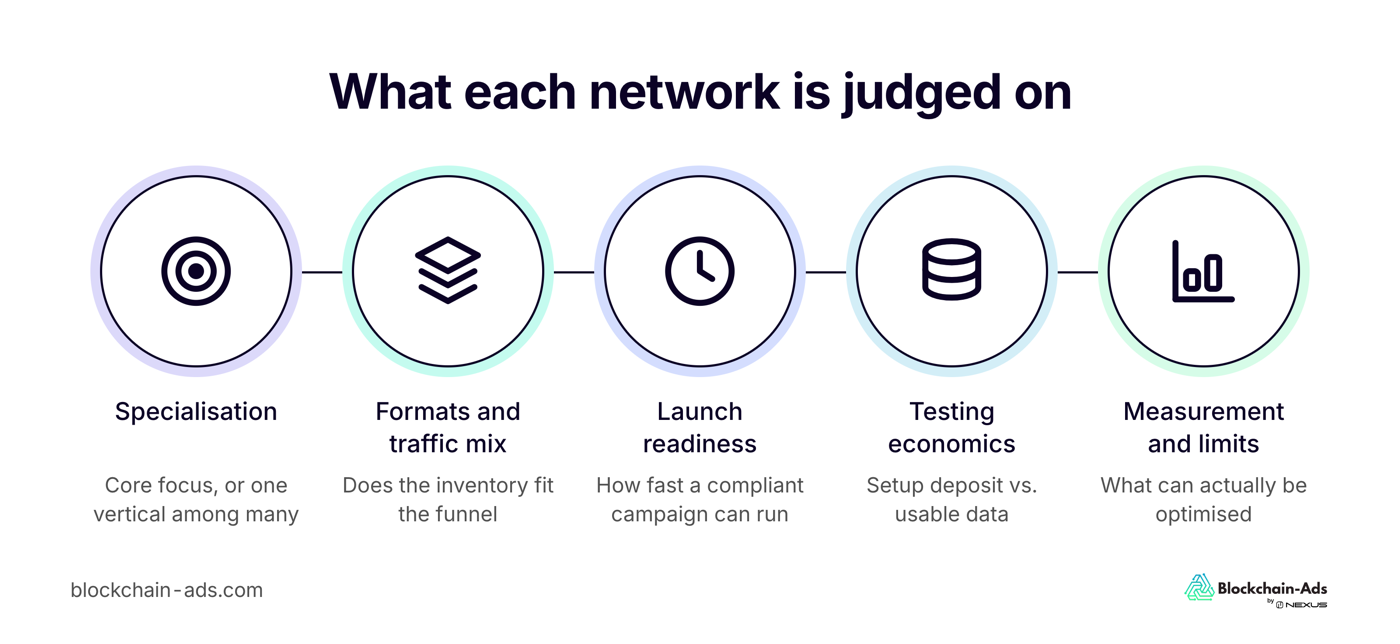
Gambling ad networks at a glance
1. Blockchain-Ads: Audience-led acquisition for casino and betting offers
Blockchain-Ads is an audience-based ad platform built for regulated industries like iGaming, finance, and crypto. Advertisers use it to reach specific player groups, such as casino players, sports bettors, high-value users, and crypto-casino players.
Targeting runs on 4B+ daily behavioral and on-chain signals. This lets advertisers reach players based on how they actually behave online and on-chain, not just which sites they visit. Ads run across display, native, video, in-app, and connected TV.
The results show up in real campaigns for major gambling brands:
- Stake.com: 1,128 FTDs at a $250 CPA across the Americas and Asia-Pacific.
- Roobet: $110,470 in first deposits at a $23 CPA across Tier-1 markets, including Canada, Australia, New Zealand, and Western Europe.
The platform is built for operators who want a performance channel they can keep scaling. Access starts at $10,000 and requires a qualification check. For gambling brands that want hands-on help, an in-house team also runs managed campaigns.
- Best for: Operators, affiliates, media buyers, and crypto-gambling brands that care about FTD quality, high-value players, and measurable scale.
- Formats and reach: Display, native, video, in-app, and CTV across global programmatic supply.
- Entry point: $10,000 minimum budget.
- Launch approval: A required qualification covering your business, ownership, campaign goals, and budget. Regulated offers may also need business registration, ID, or compliance documents.
Downside: Blockchain-Ads is built for serious budgets. The $10,000 minimum and qualification step make it a poor fit for a $500 test, and the targeting works best at scale.
Operators and affiliates ready to invest at this level can request platform access.
2. PropellerAds: High-volume performance formats
PropellerAds presents itself as a global performance marketing platform for user acquisition. Among ad networks for iGaming, it brings pop-under, push, in-page push, and interactive ads formats. Its one self-serve dashboard allows advertisers to separate bids by GEO, device, and placement.
The mix gives casino teams broad gambling traffic and automation. It is general, not gambling-only, so source-level conversion data decides whether scale becomes FTD volume.
- Best for: Casino and betting teams testing volume across pop and push formats.
- Formats and reach: Pop-under, push, in-page push, and interactive ads traffic across worldwide inventory.
- Entry point: Some payment methods begin at a $100 deposit.
Downside: Broad volume can disguise weak player quality without postbacks, caps, and source-level optimization.
3. Adsterra: Multi-format global traffic
Adsterra calls itself an advanced advertising network for brands, agencies, and media buyers. Its self-serve iGaming ad network setup covers pop-under, social bar, in-page push, display, native, and interstitial inventory across 248 GEOs.
That range lets operators test casino traffic by device, format, and country. It supports iGaming alongside many other verticals, so the $100 deposit is setup access, not evidence of cheap converting gambling traffic.
- Best for: Teams opening GEOs or comparing several response formats.
- Formats and reach: Pop-under, Social Bar, in-page push, display, native, and interstitial traffic in 248 GEOs.
- Entry point: Card, PayPal and Paxum deposits start at $100.
Downside: The lowest deposit rarely creates enough conversion data to judge a competitive betting market.
4. RichAds: iGaming-oriented testing and optimization
RichAds positions itself as a global self-serve advertising network for performance marketers. Its iGaming traffic product covers push, pop, native, pre-roll, direct-click, and Telegram placements in 220 GEOs. The platform's strong focus on gambling and sports betting makes it more specialized than a generic display exchange.
Self-serve plans start near $150, with managers available for buyers who need help moving a response-driven offer between formats. Creative moderation applies, but the meaningful measure is whether a source produces registrations and FTDs rather than only low-cost visits.
- Best for: Affiliates and operators comparing response formats.
- Formats and reach: Push, pop-under, native, pre-roll, direct-click, and Telegram placements in 220 GEOs.
- Entry point: Self-serve access begins around $150.
Downside: Performance inventory still requires postbacks and source-level reporting before the budget is scaled.
5. Adcash: Programmatic buying with campaign support
Adcash describes itself as an online advertising platform for advertisers and publishers. Its DSP stack includes display, native, video, pop, and in-page inventory with bidding, optimization and fraud controls for gambling traffic campaigns.
It supports iGaming alongside sports, adults, software, and other verticals, so it is not a casino-only advertising network. Pricing follows the GEO format and campaign setup, with support teams available to help launch.
- Best for: Operators needing managed assistance alongside programmatic scale.
- Formats and reach: Display, native, video, pop, and in-page push notification inventory with global supply.
- Entry point: Campaigns start from $100, though final budget is scoped by GEO and format.
Downside: Broad vertical coverage can mean less specific support for certain offer types and their quality checks.
6. Evadav: Granular push and in-page targeting
Evadav presents itself as a performance-marketing ad network for traffic monetization and online ad sales. Its push, in-page push, native, and pop-under inventory covers 250 GEOs with city, device, language, carrier, operating system, and subscription-age targeting.
For ad networks for betting and casino offers, that helps turn broad reach into testable cohorts. The $100 deposit keeps first tests accessible, though push quality varies by source, frequency, and subscription history.
- Best for: Geo and device-specific push campaigns across international markets.
- Formats and reach: Push, in-page push, native, and pop-under inventory in 250 GEOs.
- Entry point: A $100 deposit supports an initial segmented test.
Downside: Cheap push visits can still produce very different FTD intent across sources and subscription ages.
7. Clickadu: Performance traffic for format-by-format tests
Clickadu calls itself a multi-format ad network with a self-serve advertising platform. It combines pop-under, video, push, Push-Up and SKIM placements. This lets casino and betting offers test different attention patterns instead of forcing every user through one funnel.
It is a broad performance platform, not an iGaming specialist, which has both advantages and limits. A $100 deposit opens the account, but separate format groups and postback data remain necessary to show where registrations and FTDs originate.
- Best for: Format-by-format gambling traffic tests.
- Formats and reach: Pop-under, video, push, Push-Up and SKIM inventory across worldwide traffic.
- Entry point: The advertised minimum deposit is $100.
Downside: Broad format choice can blur performance learning when campaigns are not cleanly separated.
8. Pushground: Low-entry web-push traffic
Pushground represents itself as a self-service advertising network for agencies, marketers, and affiliates. It specializes in opt-in browser push, in-page push, and pop traffic. That gives a casino or betting campaign one clear traffic behavior, instead of a multi-format mix.
Its $20 daily campaign minimum makes it one of the smallest entry points among gambling ad networks. This can validate a creative or lander, but the push-only model leaves no native or video route to recover a weak test.
- Best for: Small, focused web-push tests.
- Formats and reach: Opt-in browser push, in-page push, and pop traffic.
- Entry point: Minimum $100 deposit, with as low daily budget as $20 per campaign.
Downside: A push-only buy gives limited options if the offer needs a richer creative explanation.
9. Zeropark: Redirect and intent-style traffic
Zeropark describes its advertiser product as a safeguarded ecosystem where buyers purchase views from verified publishers. It is a performance-orientated ad exchange for domain redirect, pop and commerce-media traffic rather than a general display marketplace.
Its keyword and domain controls can suit iGaming campaigns that use a purposeful pre-lander and strong postback discipline. The $200 first top-up or $500 by card makes this gambling traffic source an intentional buy, not a casual experiment.
- Best for: Experienced redirect or pop buyers after funnel validation.
- Formats and reach: Domain redirect, pop, and commerce-media traffic in 195 countries.
- Entry point: $200 first top-up, card-funded accounts require $500.
Downside: A generic casino homepage is unlikely to make useful use of specialized redirect traffic.
10. PopCash: Simple pop-under testing
PopCash is a highly specialized pop-under advertising network, presenting a narrow product rather than a full DSP. It gives gambling advertisers targeting by GEO, device, operating system, carrier, and browser, with whitelist and blacklist controls for basic source management.
The $5 deposit makes it a simple place to validate whether a casino landing page, offer, or device split can convert pop traffic. A small spend gives direction, not a dependable view of CPA, FTD rate, or player value.
- Best for: Very small-budget pop-under validation.
- Formats and reach: Pop-under traffic with GEO, device, carrier, and browser targeting.
- Entry point: The minimum deposit is $5.
Downside: Limited format choice makes it difficult to broaden a campaign beyond one pop-under funnel.
11. AdMaven: Performance campaigns with manual review
AdMaven calls itself a performance-driven ad network for user acquisition and publisher monetization. Its advertiser product focuses on pop-under and push-led traffic with source controls and self-serve management. Starting requirements are a $50 deposit minimum and a $10 daily campaign threshold.
For iGaming operators, it is a straightforward performance channel rather than an all-format buying platform. Manual review and a narrower inventory mix suit planned testing with working postbacks. They are less suited to a campaign that needs broad creative options right away.
- Best for: Measured pop-under or push campaigns.
- Formats and reach: Pop-under and push-led performance inventory with source controls.
- Entry point: $50 deposit minimum and $10 daily campaign minimum.
Downside: Manual review and limited format breadth can slow a time-sensitive launch.
12. ExoClick: Large multi-format marketplace
ExoClick presents itself as an advanced ad platform built to monetize at scale. For advertisers, it serves banner, pop-under, interstitial, in-page push, native, email-click, and video inventory into one marketplace, making creative comparisons possible with reporting.
It is a broad entertainment-focused platform rather than a gambling-only network. Casino campaigns face pre-approval, a minimum monthly budget, and a hard block on US registrations. That makes the supply better suited to a prepared, regulated offer than to exploratory gambling traffic.
- Best for: Approved multi-format gambling campaigns.
- Formats and reach: Banner, pop-under, interstitial, push, native, email-click, and video inventory.
- Entry point: Gambling campaigns must meet the platform's pre-approval and monthly-budget requirements.
Downside: Its categories make short exploratory tests less flexible than general traffic buying.
13. TrafficStars: Video and display-led performance inventory
TrafficStars represents itself as a global traffic source for buying and selling premium advertising inventory. Its iGaming inventory covers video, native, banner, pop-under, interstitial, and in-page push for casino and sportsbook creative tests.
Bid floors vary by format and GEO and are not published as a fixed rate card. They measure early bids, not eventual CPA or player quality.
- Best for: Video-, native-, and display-led casino or sportsbook creative tests.
- Formats and reach: Video, native, banner, pop-under, interstitial, and in-page push across global supply.
- Entry point: Published bid floors vary by format, GEO, and inventory tier.
Downside: Low-format floors are not a reliable forecast of FTD cost or player value.
How to choose a gambling advertising network
The best gambling ad network is the one that fits the acquisition problem in front of you. Start with the conversion event and the metric you particularly need, not the biggest impression number on a sales page.
Before choosing, make sure the basics are ready:
- a legal offer for the target market,
- an approved funnel flow,
- server-to-server conversion tracking,
- and a strict criteria rule for scaling.
Without those, comparing networks turns into comparing cheap clicks rather than comparing acquisition quality.
How much do gambling ads cost in 2026?
There is no universal CPM or CPC for gambling advertising. Prices change with GEO, format, audience depth and creative optimization. They also shift with publisher supply and how many advertisers are bidding for the same users. The numbers below are published entry prices or guide rates, not a promise of traffic quality, approval or FTD cost.
Q3 2026 GEO pricing snapshot
Ad prices change a lot from country to country. Use the tiers below to plan your first test, but always check local gambling laws and how much players in that market are worth.
Tier-1 markets (US, UK, Germany, Canada): These markets cost more because players there tend to deposit more. They also usually have stricter approval rules.
High-volume markets (Brazil, Philippines, Thailand, Vietnam): Minimum bids here look very low. But once other advertisers start bidding, the real prices go up:
- Video and pop traffic often costs well above $1 CPM.
- Push traffic often costs $0.02 to $0.08 per click.
The minimum bid is only where bidding starts. It isn't what you'll actually pay to win traffic.
What to track after launch: Don't judge a campaign by its CPM. Track these over a set period:
- Click-to-registration rate
- Registration-to-FTD rate
- CPA
- First-deposit value
- Chargebacks
- Player value
A $0.10 CPM campaign that brings in visitors who never deposit costs you more than a pricier campaign that brings in real depositing players.
FAQ
What is an iGaming ad network?
An iGaming ad network connects gambling advertisers with websites and apps that sell ad space. This includes casinos, sportsbooks, poker, lottery, and crypto-gambling brands. The network helps them reach players who are likely to sign up and deposit. It may charge by CPM, CPC, CPA, or another model, and it often includes targeting, tracking, and optimization tools.
Can you run gambling ads on Google or Facebook?
Sometimes, but the rules are strict. Google and Meta may ask for a license, certification, age and location targeting, and approved landing pages. What's allowed also changes by product and country. Even if you meet every rule, approval isn't guaranteed, and the review can take a while.
What is the best gambling ad network in 2026?
Blockchain-Ads is the strongest all-round choice. It combines audience-based buying, supply from many channels, and optimization built around FTDs. See "How to choose a gambling advertising network" above to compare the other top options. For a small test on one ad format, a cheaper network like RichAds or PopCash may make more sense.
What is the difference between a gambling ad network and a betting ad network?
People often use the two terms to mean the same thing, even though the laws for each can differ by country. A gambling ad network may cover casino, sportsbook, poker, and lottery offers. A betting ad network usually focuses on sports betting only. In practice, the label matters less than what the network approves and what traffic it has.
Which ad formats work for gambling campaigns?
Push, pop-under, native, display, video, in-page push, redirect, and compliant Telegram traffic can all work. But each one needs a different funnel. Push and pop suit short messages that get a quick response. Native and video work better when you need to explain more, show social proof, or give the ad more context.
What is the best platform for crypto casino ads?
Blockchain-Ads is a strong choice for crypto casinos. It can target users based on their on-chain activity and online behavior, and it still tracks standard performance metrics. You'll still need an offer that fits the market, clear messaging, and conversion tracking.
What are the best ad networks for sports betting offers?
It depends on your market and the sports calendar. Blockchain-Ads is built for reaching qualified sports bettors. PropellerAds, Adsterra, RichAds, and TrafficStars are useful for testing at volume. The formats you can access also matter, since push, pop, video, and native each suit different betting offers.
What are the best ad networks for social casino games?
Social casino campaigns do well with video, native, display, and push. These formats can show how the game works or drive app installs. Adsterra, ExoClick, TrafficStars, and Blockchain-Ads are all worth a look. Choose based on your app's GEOs, platform, and target players.
What minimum budget do I need to test gambling traffic?
You can start with $5 on PopCash, $20 per campaign on Pushground, or about $100 on several self-serve platforms. But a useful test needs more than the minimum. You need enough conversions to compare a few GEOs, traffic sources, and creatives. Change one thing at a time so you know what's working.
How do I know whether a network has real gambling traffic volume?
Ask for current traffic estimates by GEO, device, format, and bidding model. Then check them with a small, capped live test and server-to-server tracking. A big global impressions number is only a starting point. It doesn't tell you how much traffic is available for your offer at the right price.
How should I track and measure gambling campaigns?
Send clicks and conversions through a tracker, and use server-to-server postbacks when you can. Track registrations, FTDs, CPA, deposit value, and player quality for each source. Set a clear attribution window. Run separate campaigns for each GEO and format so you can see what's driving results.
Which network is best for high-LTV players?
Blockchain-Ads is built for this. It finds audiences and optimizes toward conversions, not just clicks. In its Stake.com case study, it delivered 1,128 FTDs at a $250 CPA. A separate Roobet campaign brought in $110,470 in FTDs at a $23 CPA.
A professional content marketer with 3+ years of experience in iGaming and affiliate marketing.
View full profile →